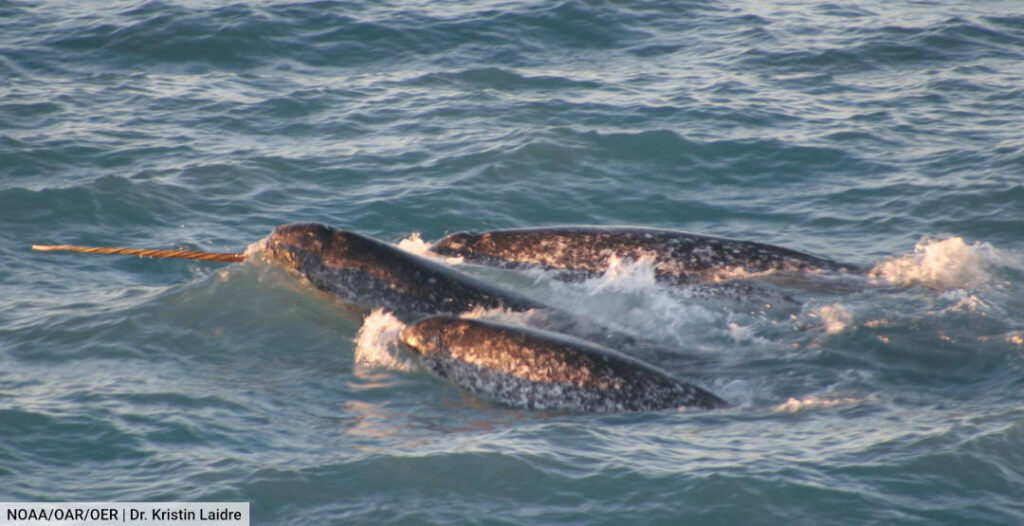
This page contains narwhal facts, information, pictures and video. Read on to find out more about this mysterious Arctic whale …
This article is part of our Arctic Animals series.
Page Index
Narwhal Facts At A Glance
- Scientific Name: Monodon monoceros
- Subspecies: None recognized
- Order: Cetacea
- Class: Mammalia
- Family: Monodontidae
- Genus: Monodon
- Male Weight: 800–1,600 kg (1,760–3,530 lb)
- Female Weight: 600–1,000 kg (1,320–2,200 lb)
- Male Length: 4.0–5.3 m (13–17 ft) including tusk (tusk can reach up to 3 m / 10 ft)
- Female Length: 3.5–4.5 m (11.5–15 ft)
- Where Found: Arctic waters of Canada, Greenland, Russia, and Norway
- Typical Habitat: Cold Arctic marine environments; prefers deep fjords, coastal bays, and offshore pack ice areas
- Diet: Carnivorous – feeds primarily on Greenland halibut, Arctic cod, squid, and shrimp; capable of deep dives exceeding 1,500 meters
- Conservation Status (as of Feb 2026): Least Concern
Narwhal Information
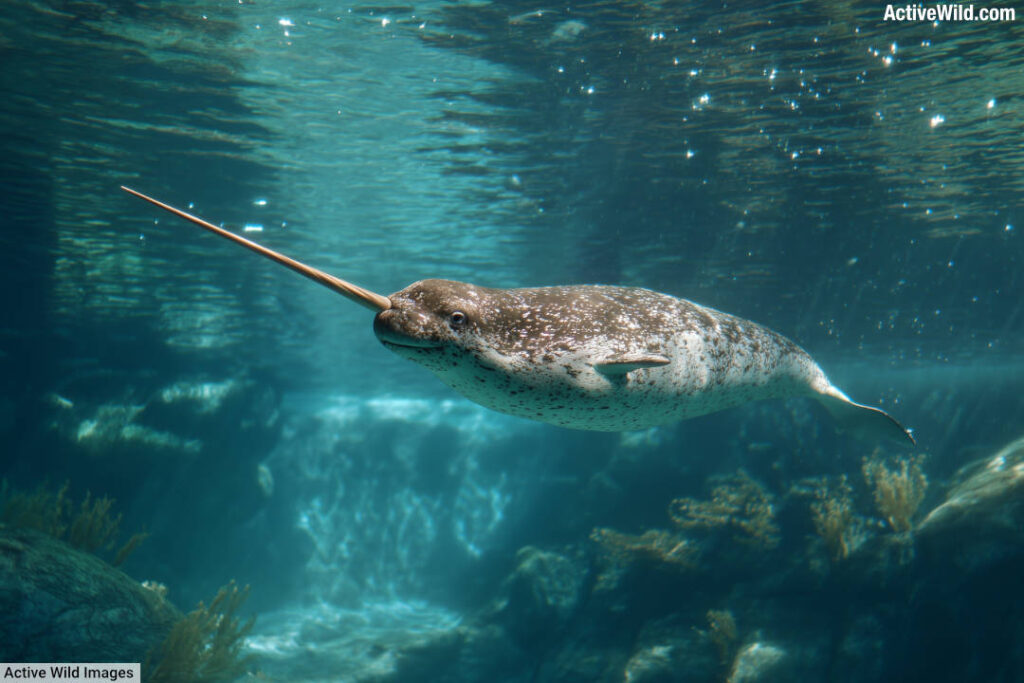
The Narwhal is known as the ‘unicorn of the ocean’ due to its distinctive horn, and this marine mammal is almost as mysterious as its mythical namesake.
The Narwhal’s scientific name is Monodon monoceros. It is a member of the Monodontidae family, which is part of a larger group of animals known as the ‘toothed whales‘. Other toothed whales include dolphins, porpoises, and even the fearsome killer whale!
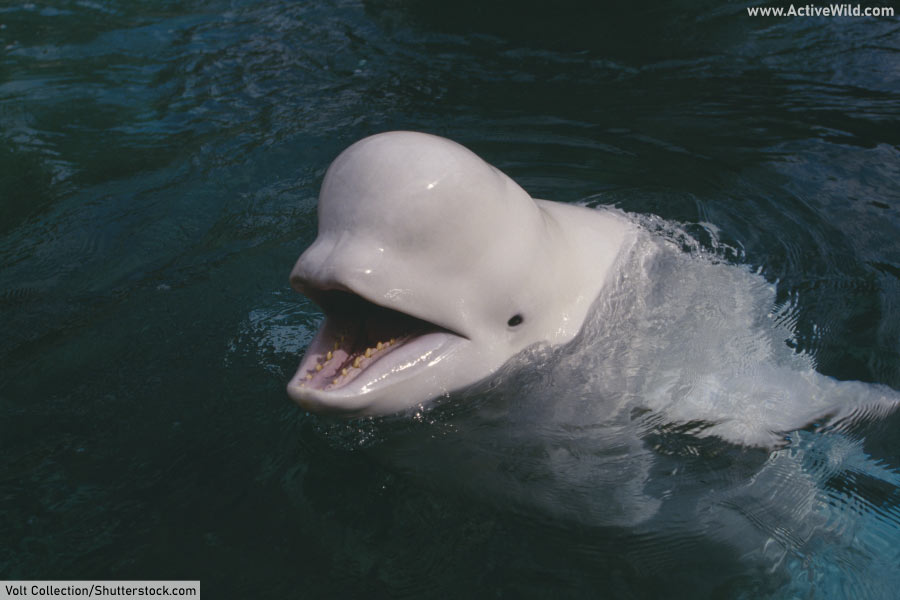
The only other species in the Monodontidae family is the closely-related Beluga Whale. You can find out more about Beluga Whales on this page: Beluga Whale Facts.
Like all whales, the narwhal is a mammal, and has to come up to the surface of the water to breathe.
What Does The Name “Narwhal” Mean? (Warning: It’s A Bit Gruesome!)
The name narwhal comes from the Norse word ‘nar’, which means ‘corpse’. It refers to the mottled skin of the narwhal, which was thought to resemble the bodies of drowned sailors.
The Narwhal’s Tusk
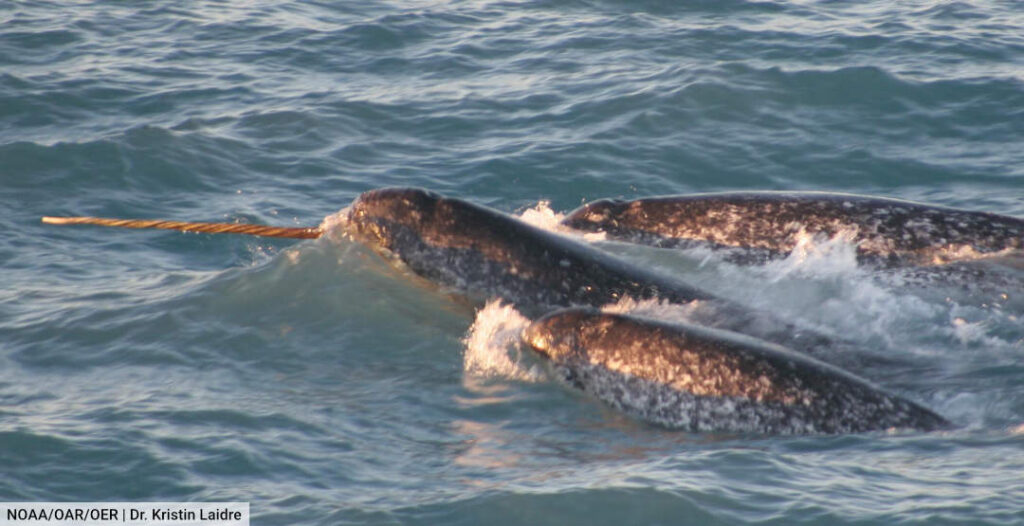
The narwhal’s tusk is easily its most distinctive feature. The tusk is actually an elongated left canine tooth, and is one of the longest teeth of any mammal.
In general, only male narwhals have tusks. It’s very rare for female narwhals to grow tusks, and when they do, they are typically much shorter.
The tusk of a narwhal can grow up to 3 meters (about 10 feet) long, but most adult male tusks measure 1.5–2.5 meters (5–8 feet).
Some male narwhals grow two tusks, although this is very rare.
The narwhal’s tusk is thought to have evolved primarily as a sexually selected trait used for social signaling and mate competition among males, possibly also serving a sensory function.
Missing Dorsal Fin!
Another unusual feature of the narwhal is the lack of a dorsal fin. (That’s the fin on the back of most whales). The lack of a dorsal fin is widely believed to be an adaptation to Arctic ice environments, improving maneuverability under the ice, reducing heat loss, and minimizing injury risk under sea ice.
How Big is a Narwhal?
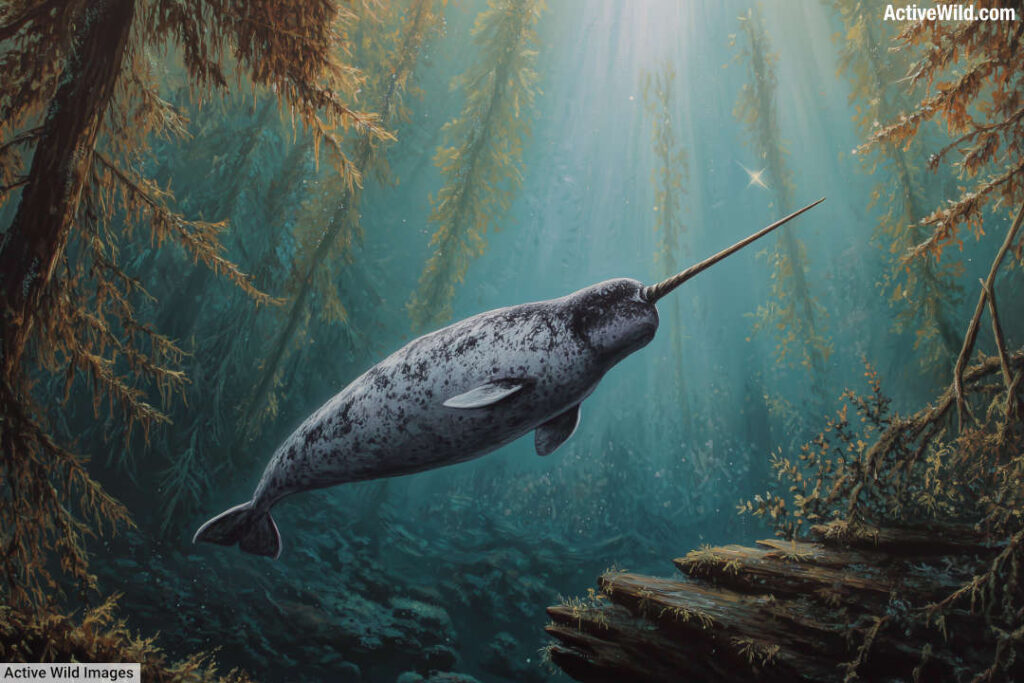
The Narwhal is a medium-sized whale, with males typically reaching 4–5 meters (13–16 feet) in length and weighing up to 1,600 kilograms (3,500 pounds), while females are slightly smaller. Its body is streamlined and lacks a dorsal fin, instead featuring a low, ridged back that aids movement beneath Arctic ice.
Narwhals have short, rounded flippers, a relatively small head with no distinct beak, and a mottled gray, brown, and white coloration that becomes lighter with age, with some older individuals appearing almost entirely white.
Lifespan
The Narwhal can live at least 50 years, and some individuals are estimated to reach 60 years or more in the wild.
Age estimates are based on growth layers in their teeth and eye lens proteins, similar to techniques used for other long-lived Arctic whales.
What Do Narwhals Eat?
The Narwhal is a deep-diving predator that feeds mainly on Greenland halibut, Arctic cod, squid, and shrimp, especially during winter months. It forages at depths of 800–1,200 meters (2,600–3,900 feet), using echolocation clicks to locate prey in dark, ice-covered waters.
Narwhals typically make repeated deep dives in succession, capturing prey with quick suction feeding rather than active chasing, an energy-efficient strategy suited to the extreme Arctic environment.
Where Do Narwhals Live?
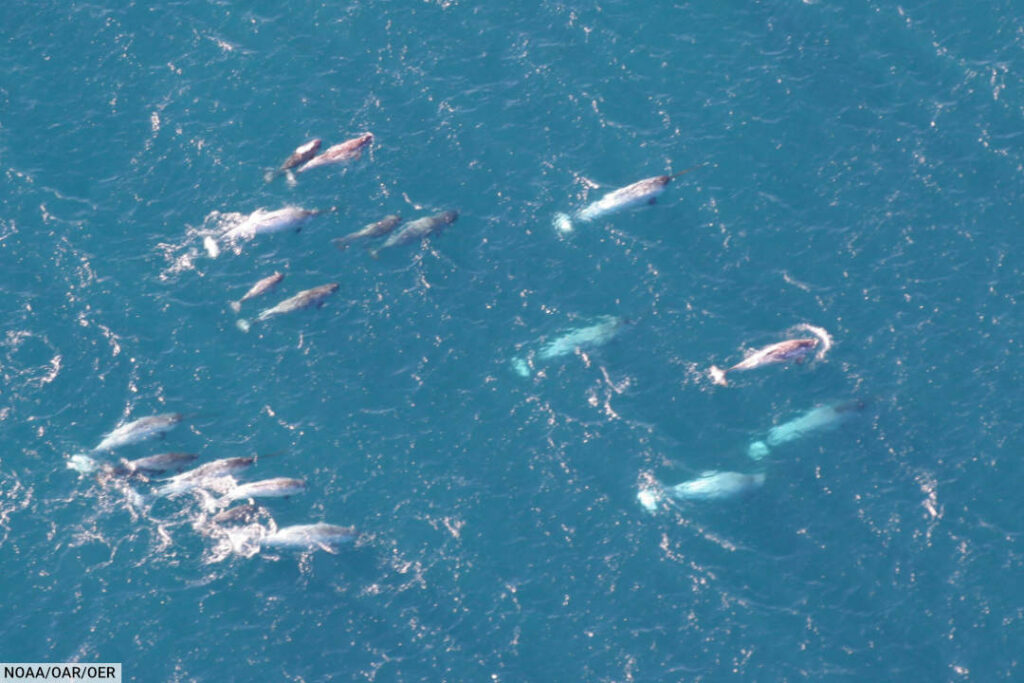
The Narwhal is found exclusively in Arctic waters, primarily around Canada, Greenland, and parts of Russia, where it inhabits deep fjords and coastal bays in summer before migrating offshore in winter to dense pack ice over deep ocean basins.
Rather than undertaking long-distance north–south migrations like many whales, narwhals follow seasonal sea ice patterns, moving between relatively predictable summering grounds and wintering areas while remaining within the high Arctic year-round.
It’s thought that there are around 120,000 adult Narwhals alive in the wild today.
Narwhal Behavior & Life-Cycle
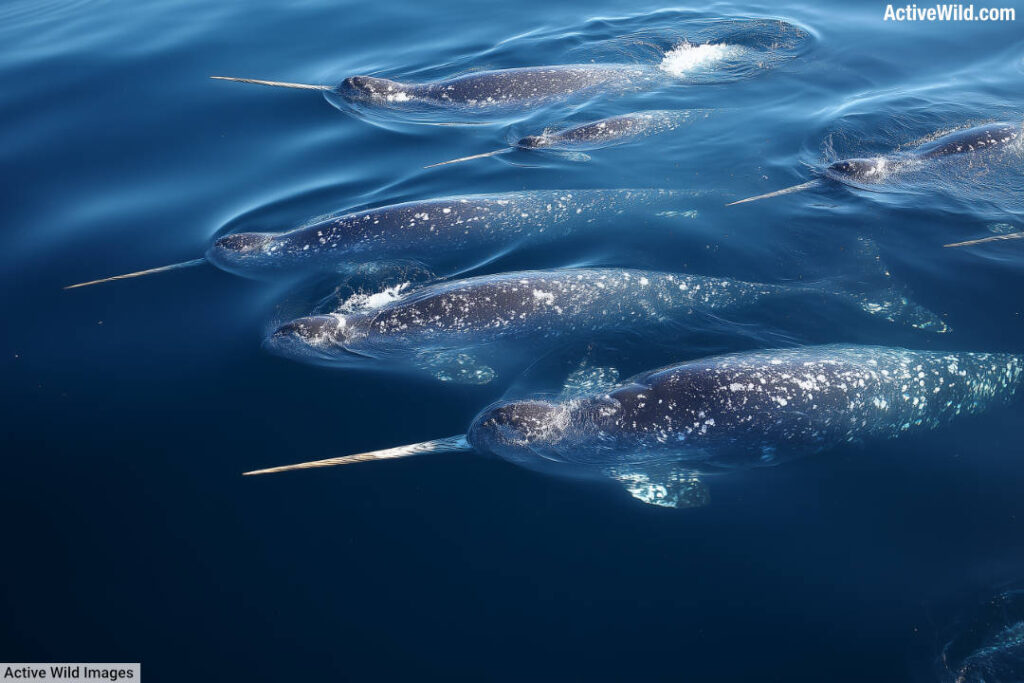
The Narwhal is a social whale that typically travels in pods of 5–20 individuals, though groups can number in the hundreds during migration.
Pods are often segregated by sex and age, with adult males sometimes forming bachelor groups and females traveling with calves.
The whales rely heavily on acoustic communication to maintain cohesion in dark, ice-covered waters, and their social interactions may include coordinated diving and close physical positioning beneath the pack ice.
Narwhals have a slow life cycle typical of Arctic whales. Females reach sexual maturity around 6–8 years of age and give birth to a single calf after a gestation period of about 14 months, usually in summer.
Calves nurse for more than a year and remain closely associated with their mothers during early development. With lifespans exceeding 50 years, narwhals reproduce infrequently, making populations particularly sensitive to environmental change and human pressures.
Are Narwhals Endangered?
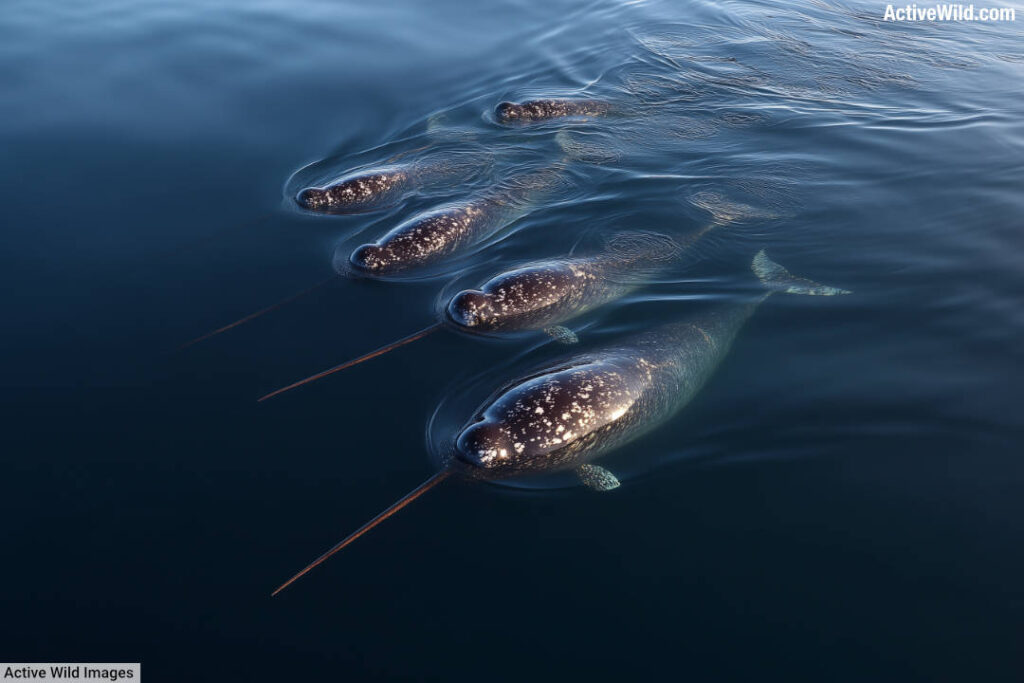
At the time of writing (Feb 2026), the Narwhal has the conservation status “Least Concern”, and is not presently endangered.
The narwhal’s natural predators include Polar Bears and Orcas. Narwhals are also hunted (legally) by native Inuit people, who use all parts of the whale for food, tools and even for making art.
Narwhal Facts – Summary
- Narwhals belong to the superfamily Delphinoidea, a group of animals also known as “toothed whales”. This superfamily also contains dolphins, porpoises, and even the killer whale! (Unfortunately, this doesn’t stop killer whales from hunting narwhals!)
- Narwhals belong to the family Monodontidae. The only other member of this family is the Beluga whale.
- Narwhals communicate primarily through high-frequency clicks for echolocation and whistles and pulsed calls for social interaction, relying on sound to navigate, hunt, and stay connected in dark Arctic waters.
- Narwhals don’t have a dorsal fin, which makes it easier for them to live under the Arctic ice.
- Narwhal gatherings of up to several thousand individuals have been seen.
- Some male narwhals can have two tusks!
- Narwhals can dive to depths of over 1,500 meters (4,900 feet – almost one mile!) and typically stay underwater for 20–25 minutes, sometimes exceeding 30 minutes while hunting deep beneath Arctic ice.
- Narwhals change colour during their lives; babies are blue-grey, adults mottled grey and the older individuals can be almost completely white.
- Narwhals can sometimes be suffocated when the sea ice freezes over.
- The scientific name for a narwhal is Monodon Monoceros, which means “one-toothed one-horn,” referring to the narwhal’s single prominent tusk.
Discover More with Active Wild
Discover more about the Arctic, Arctic animals, whales and mammals on the following pages:
- Artic Animals List with Pictures & Facts – discover many more amazing Arctic animals!
- The Arctic – A Complete Guide – find out interesting facts about this frozen land!
- Types Of Whales – EVERY Species Listed – Discover every whale species, with interesting facts on these incredible ocean giants!
- Mammals – The Ultimate Guide – Whales (including the narwhal) are mammals (just like us!). On this page, you’ll discover incredible facts about mammals.
The post Narwhal Facts, Pictures & In-Depth Information appeared first on Active Wild.