
This is the final post in the National Sustainable Agriculture Coalition (NSAC)’s series documenting the ongoing staffing crisis across the US Department of Agriculture (USDA). The scale and pace of staffing losses across the USDA, combined with the uncertainty introduced by a sweeping USDA reorganization plan, have weakened the Department at the very moment farmers face rising production costs, unstable markets, and climate-driven disasters. As the series comes to an end, the data show a workforce under extreme strain and an urgent need for renewed investment in the staff that make the People’s Department function.
A Year Defined by Unprecedented Staffing Losses
Beginning in January 2025, USDA experienced historic staff losses. Nearly 3,000 employees separated from the agency in the first quarter alone, according to the Office of Personnel Management. These early losses included both career staff, many with 20 years or more of institutional knowledge, and recent hires who had not yet completed their first year of service.
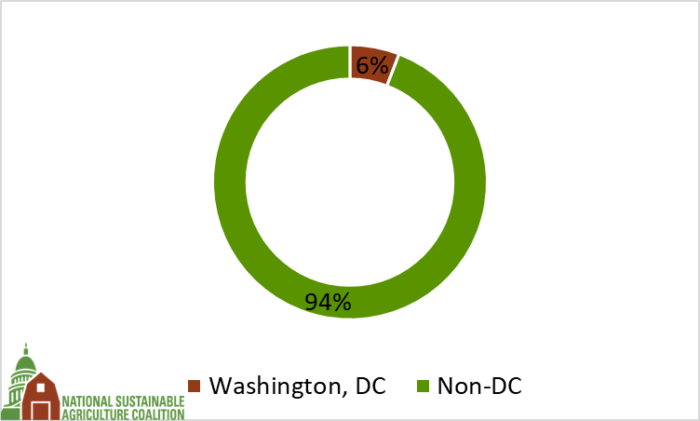
The truly unprecedented staff losses followed soon after, with roughly 15,173 USDA employees who accepted Deferred Resignation Program (DRP) buyouts. 94% of the USDA staff who left via the DRP were located outside of the Washington, DC area. All of the staff who accepted the DRP officially separated from the agency on September 30, 2025.
Figure 1: Location of USDA Staff Who Left Via DRP
The consequences of these losses were immediate.
- Natural Resources Conservation Service (NRCS), already struggling to meet rising farmer demand, lost planners, conservationists, and program technicians whose expertise cannot be easily replaced. Promising conservationists like Gretchen Troutman and Josh Hardin are no longer there to help farmers design conservation plans and get funding to protect and enhance the resources that ensure their farm’s viability.
- Farm Service Agency (FSA) lost staff responsible for administering farm loans, disaster assistance, and commodity programs—programs that require precise and timely processing to keep farms solvent. FSA offices like the Oklahoma office where Kevin Dale used to work have had their staff cut in half or are fully vacant, even as work demands increase with the need to allocate 30 million new base acres and administer an additional $ 12 billion in farm financial assistance.
- Food Safety and Inspection Service (FSIS) and Animal and Plant Health Inspection Service (APHIS) lost experienced inspectors, veterinarians, and scientists, threatening on-the-ground food safety capacity.
- Rural Development offices lost staff with an average of 13.5 years of service, with losses concentrated among both the most junior and most experienced employees, leaving gaps in both institutional memory and the future of the agency. These Rural Development staff administer programs like the Meat and Poultry Processing Expansion Program (MPPEP) to help grow rural economies.
- The research agencies Economic Research Service (ERS), National Institute of Food and Agriculture (NIFA), and Agricultural Research Service (ARS) lost economists and scientists whose research supports federal decision-making, weakening USDA’s capacity to produce market forecasts, evaluate rural well-being, and administer competitive research grants.
Taken together, the federal workforce responsible for serving farmers and supporting rural communities shrank dramatically in a matter of months.
A Reorganization Plan That Accelerates Risk
In July 2025, USDA announced a major reorganization plan, drafted without public input, that would relocate thousands of jobs, consolidate field offices, and restructure core program functions. Early details suggest the relocation of up to 2,600 headquarters and regional staff, along with the consolidation or closure of field offices across NRCS, FSA, Rural Development (RD), and other agencies. US Secretary of Agriculture Brooke Rollins has publicly stated that she expects up to half of the staff to leave the department rather than relocate.
For agencies already operating with gutted staff and the loss of institutional knowledge, this reorganization introduces additional uncertainty. Staff have been given limited details about timelines, office closures, reassignments, or new reporting structures. Farmers and stakeholders have been offered no clarity on how service delivery might be affected. During their adhoc public comment period on the reorganization, the USDA received nearly 47,000 emails. Their own analysis concludes that 82% of the responses expressed negative sentiment and concerns.
The risks of USDA reorganization are clear. The deepest staffing losses occurred in agencies already stretched thin and struggling to meet farmer demand, leaving many USDA programs operating with minimal capacity at a time when farmers are facing a worsening financial crisis. Farmers rely on these agencies for conservation planning, loan processing, and disaster assistance. Any reorganization risks amplifying service gaps precisely when farmers need USDA support the most.
The Shutdown and Reopening
When the government shut down on October 1, 2025, the incredible importance of USDA staff and services became even more evident. Outreach events were canceled, conservation planning stalled, and loan processing halted.
Farmers like Lindsay, from Tourvaille Farm in Ohio, could not get their conservation contracts paid on time because staff were furloughed. Others like Celeste, a farmer from Washington, didn’t receive their much-needed farm loans and safety net payments. These and the hundreds of other stories of American farmers and rural communities unable to access the resources and services they depend upon made visible the often-overlooked importance of USDA staff.
The bill to reopen the government – passed on November 13, 2025 – included several provisions that shape the future of USDA staffing and services:
- First, the bill provided full-year funding for USDA, ensuring that USDA staff will not be furloughed for the remainder of the 2026 fiscal year.
- Second, Congress inserted new oversight requirements that could limit USDA’s ability to move forward with large-scale reorganizations, relocations, or office closures. This represents one of the first meaningful checks on the reorganization since its announcement.
- Third, the legislation stabilized funding for research and scientific programs. These investments protect programs critical for research and economic forecasting, areas where staff was already thinned due to the 2025 staff losses.
However, the shutdown bill did not reverse the staffing losses the USDA has already endured. It did not pause the reorganization, only slowed it and perhaps established some guardrails. And it did not provide any emergency hiring authorities or explicitly additional staffing budgets that agencies desperately need to rebuild.
Charting a Path Forward for Federal Agricultural Capacity
The USDA staffing crisis of 2025 makes clear that the department’s capacity has been compromised at a moment when robust federal support for farmers is most essential. If these staff losses are not addressed, access to USDA services will become more uneven and core missions of the USDA, from conservation to farm resilience, food safety, and rural development, will suffer.
NSAC urges the Administration and Congress to rebuild staffing across all USDA mission areas and pause the reorganization until a transparent and iterative process is laid out to meaningfully integrate stakeholder input. USDA must prioritize immediate hiring in NRCS, FSA, RD, and other agencies suffering acute shortages. No USDA reorganization and structural change should proceed until USDA conducts a transparent impact assessment, engages meaningfully with farmers and frontline staff, and demonstrates that proposed changes will strengthen, not weaken, service delivery.
The past year has shown how deeply USDA’s ability to serve the public depends on a strong and stable workforce.
The post USDA Staffing Crisis: A Year of Losses and the Road Ahead appeared first on National Sustainable Agriculture Coalition.